Ottawa, ON January 15, 2026 – The Canadian Real Estate Association (CREA) has updated its 2026 forecast for home sales activity and average home prices via the Multiple Listing Service® (MLS®) Systems of Canadian real estate boards and associations and extended the outlook to include 2027.
One year ago, expectations were that 2025 would mark a turning point, with buyers beginning to come off the sidelines after a significant slowdown across many Canadian housing markets. That slowdown coincided with the Bank of Canada’s use of higher interest rates to fight—and ultimately win—its first battle with inflation since adopting its inflation-targeting mandate in 1992.
While the economic uncertainty resulting from U.S. tariff threats ultimately resulted in another slow year for housing in 2025, most of that weakness was front loaded in the first months of the year. Beginning in April, the market underwent a rally that saw sales climb 12% by August. While this slowed into more of a holding pattern to finish the year, it’s that mid-year upward trend that is expected to pick up once again in 2026.
A major factor underpinning this forecast for higher activity in 2026 is pent-up demand, particularly from first-time buyers, many of whom have been shut out of the market over the past four years. While interest rates have not fallen as far as many may have hoped for, they have likely fallen far enough to restore the attainability of homeownership for many, despite affordability that remains more challenging than it was prior to 2020.
A significant milestone was reached on October 29, 2025, when the Bank of Canada indicated clearly that rates were likely about as good as they were going to get, which could draw in borrowers who had been waiting for that signal before taking on a fixed-rate mortgage.
On the supply side, an important factor to watch in 2026 is the pace at which inventory could be drawn down if demand is driven disproportionately by first-time buyers, as expected. First-time buyers remove listings from the market without adding new supply, accelerating inventory depletion.
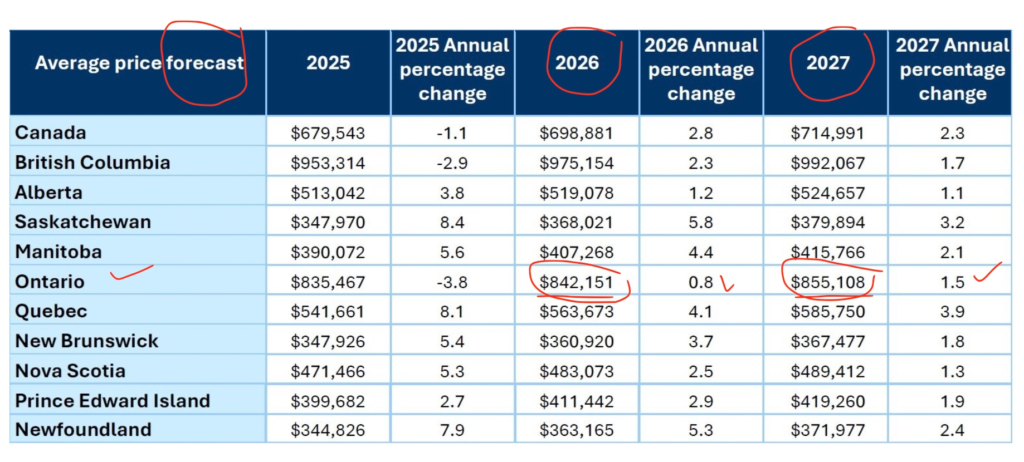
Some 494,512 residential properties are forecast to trade hands via Canadian MLS® Systems in 2026, representing an increase of 5.1% from 2025. As previously forecast, the national gain is still expected to be driven largely by British Columbia and Ontario where sales have much more room to recover. Activity in B.C. and Ontario is forecast to rise by more than 8% in 2026, with gains of less than half that in most other provinces where sales are already running at higher levels and where supply is far more constrained.
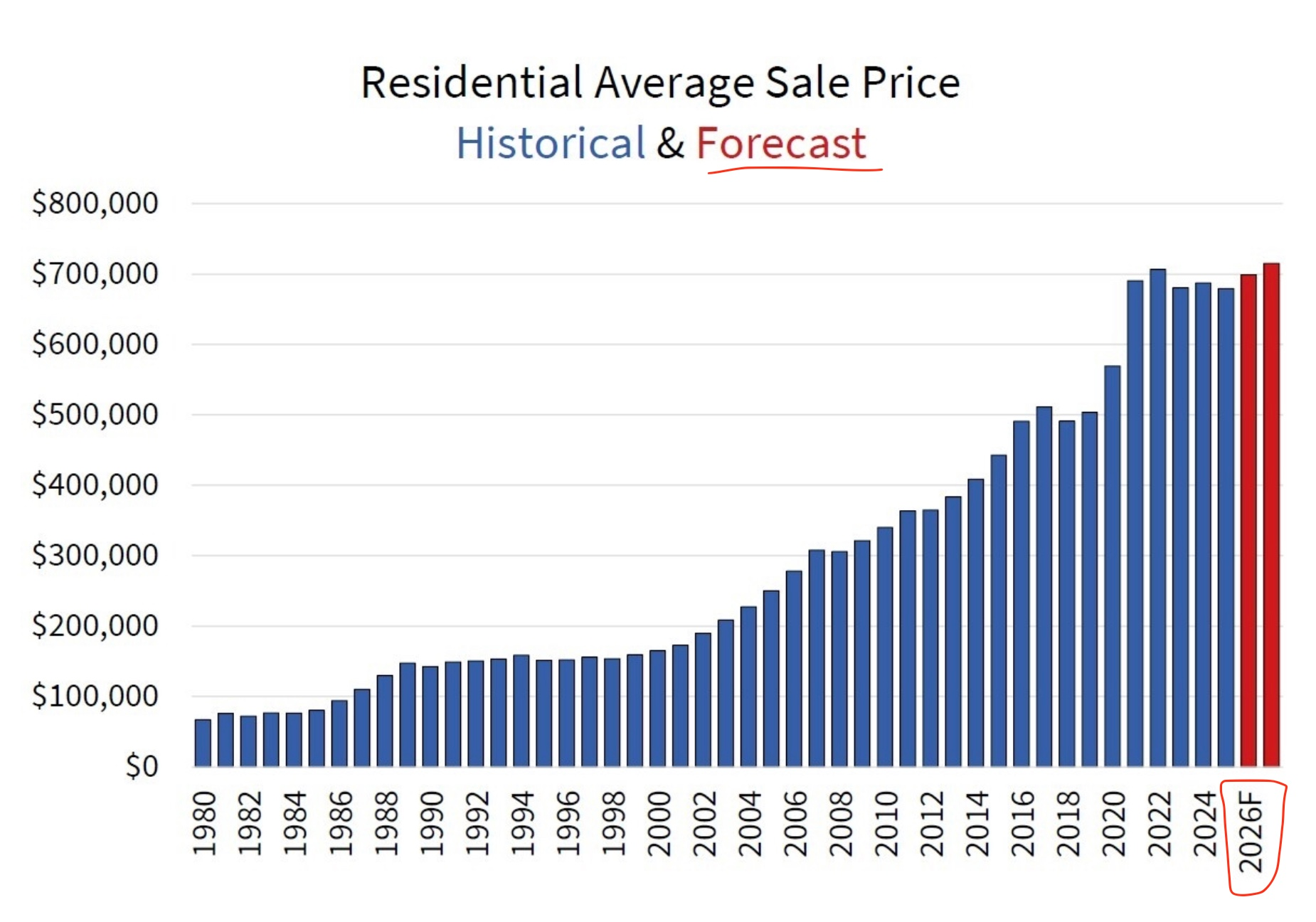
The national average home price is forecast to rise by 2.8% on an annual basis to $698,881 in 2026, with smaller increases in B.C., Alberta, Ontario, and Nova Scotia, and larger gains in other provinces where prices have continued to climb at a decent clip in recent years, particularly Saskatchewan, Quebec, and Newfoundland and Labrador. That said, as much of that growth has been bolstered by record population growth up until recently, price gains in those hotter markets are forecast to be markedly lower than the gains recorded in 2025, falling from the 6%-8% range in 2025 to the 3%-6% range in 2026.
In 2027, national home sales are forecast to climb a further 3.5% to 511,966, again led by B.C. and Ontario, with most other provinces settling into growth in the low single digits.
The national average home price is forecast to edge up by 2.3% from 2026 to $714,991 in 2027, with slightly larger gains in Saskatchewan and Quebec, and other provinces in the 1%-2.5% range. This would mark the seventh straight year that the national average home price has hovered close to the $700,000 range.
Each quarter, CREA updates its forecast for home sales activity and average home prices via Multiple Listing Service® (MLS®) Systems of Canadian real estate boards and associations. CREA’s next forecast will be published on Thursday, April 16, 2026.
(CREA) source
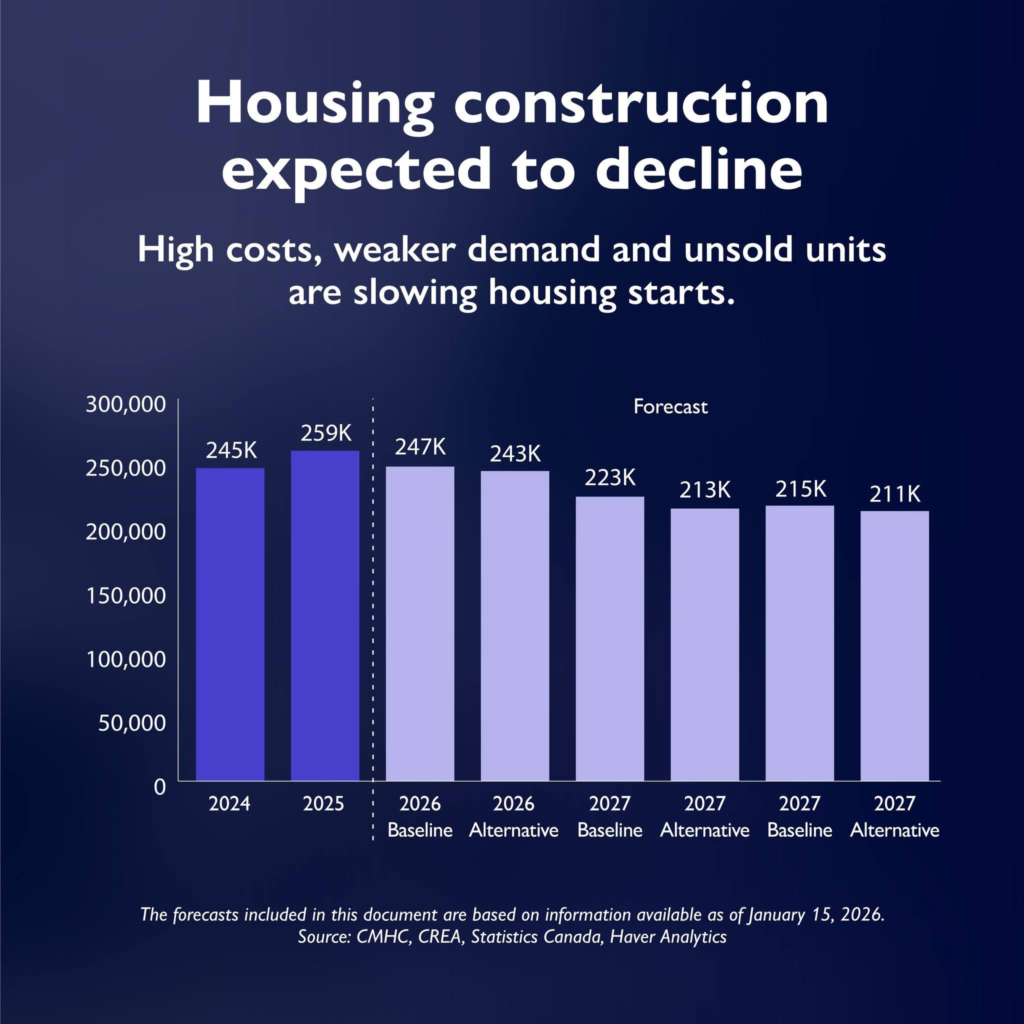
In Ottawa, the 2026 market is currently defying the traditional “supply vs. demand” panic. While new construction is slowing down, the city is actually leaning into a Buyer’s Market in specific price brackets, creating a unique window for those looking to move up or enter the market.
Here is how the lack of construction is playing out specifically in the National Capital Region:
The Ottawa Paradox: Low Construction, High Inventory
Usually, a 16% drop in new home sales (like we saw this January) would signal a price spike. But in Ottawa, several local factors are keeping prices steady or even dipping:
The Resale Surge: While builders are breaking ground on fewer homes, active listings in Ottawa have jumped by 23% compared to last year. Buyers now have over 4.4 months of inventory to choose from—the highest level in years.
The Segment Split: * Under $700k (Townhomes): Still a competitive Seller’s Market because affordability is king.
$700k – $1M (Detached): A Balanced Market where you can negotiate.
Over $1M (Luxury/Executive): A Strong Buyer’s Market. If you are looking to “move up” into a high-end detached home, you have significant leverage right now.
Why “The Time is Now” for Ottawa Buyers
The window for 2026 is “ripe” because we are in a temporary lull before the construction gap catches up to us in 2028.
Negotiation Leverage: Homes are sitting on the Ottawa market for an average of 49 days. In January, homes sold for an average of 2.6% below the asking price. That’s thousands in savings right off the top.
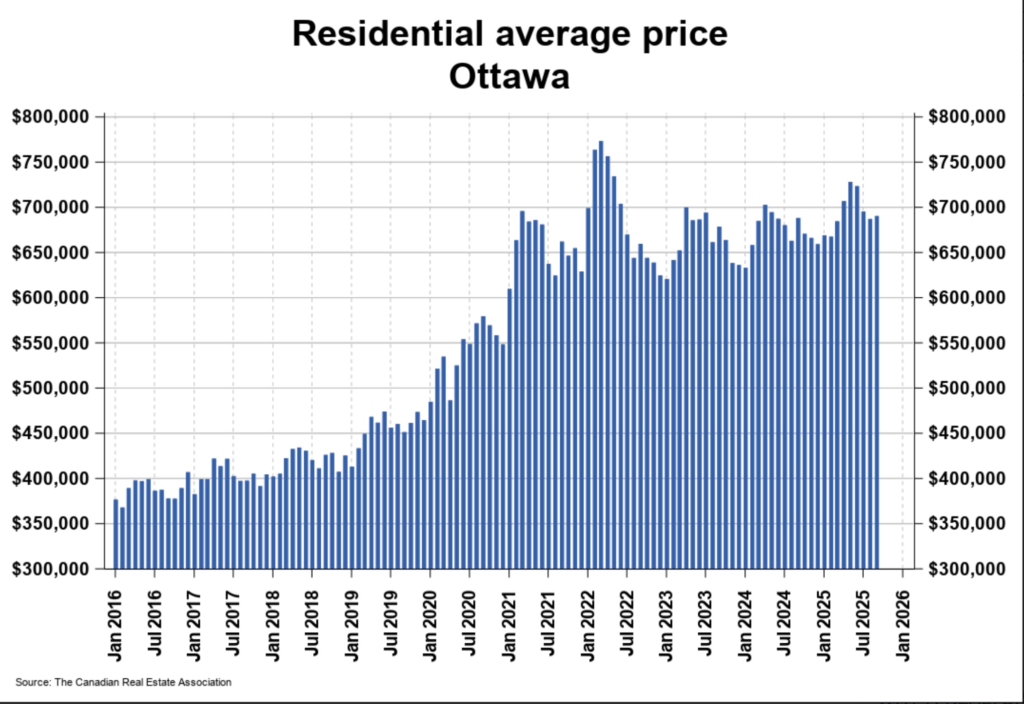
Price Stability: The benchmark price in Ottawa recently hit its lowest point since early 2024 ($606,700). This “bottoming out” phase is exactly when savvy buyers step in before the next growth cycle.
New Incentives: For those looking at new builds, the proposed HST rebate could save first-time buyers up to $130,000 on homes under $1 million—a massive game-changer for those who felt priced out.
2026 Ottawa Market Snapshot
Your Strategy for 2026 should be:
If you’re thinking of moving up to a better home, the “move-up gap” (the price difference between your current home and the next level) is at its narrowest point in years.
The risk isn’t buying now—it’s waiting until 2027/28 when the current lack of construction creates a massive shortage, inevitably driving prices back up once interest rates settle.


 -3.3%
-3.3%